Crawl Space Water Damage Restoration
When standing water appears under your home, every hour makes the damage worse. Crawl space water damage restoration is not just about pumping out what you can see. Moisture soaks deep into structural floor joists, ruins subfloor insulation, and creates the ideal environment for toxic mold to colonize within 24 to 48 hours of flooding.
Crawl Space Recovery is America's dedicated crawl space restoration company specializing exclusively in crawl space water emergencies. Operating across 45 states with 24/7 emergency dispatch, our IICRC-certified restoration crews arrive fully equipped to perform standing water removal, flooded crawl space cleanup, sewage extraction, structural subfloor drying, and EPA-registered antimicrobial sanitization the same day you call.
From burst supply pipes to failed sump pumps to groundwater flooding, we manage the entire restoration process and bill your homeowners insurance directly so you pay only your applicable deductible on covered claims.
- Crawl Space Specialists
- Mold Stopped Before It Spreads
- Every Job Documented With Thermal Imaging
Why 100% Specialization Matters in Crawl Space Water Damage Restoration
Most property restoration companies treat crawl spaces as an occasional side service while focusing their attention on residential carpet cleaning, fire damage, and roof tarping. Conversely, basement waterproofing companies focus on selling expensive proprietary drainage systems rather than mitigating acute water emergencies. Crawl Space Recovery is fundamentally different.
| Restoration Capability | Crawl Space Recovery (Dedicated Specialists) | General Restoration Franchises | Waterproofing Sales Contractors |
|---|---|---|---|
| Primary Business Focus | 100% dedicated exclusively to crawl space water damage | Divided across fire, smoke, carpet cleaning, and roofing | Focused on selling expensive waterproofing packages |
| Emergency Response Time | Mobile units dispatched immediately nationwide - Call Now. We Answer 24/7 | 4 to 24 hour dispatch window through call centers | Scheduled sales appointments days or weeks out |
| Water Extraction Equipment | Industrial submersible trash pumps and slurry hydro-vacs | Standard utility pumps and residential shop vacuums | Do not provide emergency pumping services |
| Structural Drying Standards | ANSI/IICRC S500 certified drying to under 16% WME | Basic fan placement without comprehensive moisture logs | No structural wood drying or psychrometric mapping |
| Wet Insulation & Biohazard Removal | Immediate removal, bagging, and EPA biocide sanitization | Often subcontracted out or delayed | Do not handle wet insulation or sewer muck |
| Insurance Claim Handling | Itemized Xactimate billing with direct carrier processing | Standard general contractor invoicing | Typically self-pay only with no insurance billing |
| Vapor Barrier Standards | Heavy-duty 12 to 20-mil reinforced antimicrobial liners | Thin 6-mil builder plastic loosely laid on soil | Upsold encapsulation packages ($15,000+) |
| Proof of Completion | Official Certificate of Structural Dry-Out provided | Verbal confirmation upon equipment pickup | Warranty on drainage hardware only |
Our Complete Crawl Space Water Damage Restoration Services
Crawl Space Recovery handles every stage of crawl space water damage restoration from the moment standing water is found under your home to the day we hand you a Certificate of Structural Dry-Out. Every service listed below is performed by our in-house IICRC-certified technicians nationwide. Nothing is subcontracted. Nothing gets missed.
Inspection and Assessment
Emergency Crawl Space Water Damage Inspection
Complete on-site assessment of water intrusion sources, saturation extent, and structural condition before any equipment is placed.
Moisture Mapping and Detection
Pin-type and non-invasive capacitance meters map moisture levels across floor joists, sill plates, subfloor sheathing, band joists, and foundation walls.
Thermal Imaging Inspection
FLIR thermal cameras detect hidden moisture inside wall cavities and subfloor sheathing that no one can see with the naked eye.
Water Contamination Category Assessment
We classify the water as Category 1 clean water, Category 2 gray water, or Category 3 black water before extraction begins. This classification controls every protocol that follows.
Structural Damage Assessment
Floor joists, subfloor sheathing, sill plates, and support beams are inspected and documented to identify what can be dried and what requires structural repair or replacement.
Crawl Space Air Quality Testing
In homes where flooding has been present for more than 48 hours, we test airborne mold spore counts to determine whether HEPA containment and negative air pressure are required before work begins.
Emergency Water Removal
Emergency Crawl Space Water Extraction
Industrial extraction equipment deployed immediately upon arrival. We begin pulling water within minutes, not hours.
Standing Water Removal
High-powered wet extraction vacuums clear water from low-lying soil depressions, areas around pier footings, and spots submersible pumps cannot reach.
High-Volume Submersible Pump Extraction
For standing water two inches or deeper, industrial 2-inch and 3-inch submersible trash pumps move up to 18,000 gallons per hour, handling suspended silt, mud, and debris without clogging.
Truck-Mounted Vacuum Slurry Extraction
After primary pumping, contaminated mud, thick sediment, and stagnant sludge are removed using truck-mounted vacuum systems that reach what submersible pumps leave behind.
Flooded Crawl Space Cleanup
Physical removal of mud deposits, organic debris, displaced insulation fragments, and contaminated sediment from the crawl space floor before drying equipment is placed.
Crawl Space Sewage Water Removal
Category 3 sewage extraction using dedicated contaminated-fluid equipment kept entirely separate from standard water extraction tools, performed by technicians in full OSHA-compliant PPE.
Structural Drying and Dehumidification
Crawl Space Structural Drying
Complete commercial drying system deployment targeting the IICRC-recommended threshold of below 16 percent Wood Moisture Equivalent across all structural framing.
Crawl Space Dehumidification Service
Industrial LGR dehumidifiers removing 130 to 220 or more pints of water per day, operating in conditions where household units fail.
Industrial Air Mover Drying
High-velocity axial air movers producing over 3,000 CFM positioned across joist bays to pull bound moisture out of structural wood fibers and into the air for dehumidifier extraction.
Floor Joist Drying
Equipment positioned specifically to direct airflow across joist faces and into joist bays, targeting the highest-moisture framing members first.
Subfloor Drying
Aggressive drying of plywood and OSB subfloor panels in the first 24 hours to stop permanent delamination and panel swelling before it becomes irreversible.
Crawl Space Soil Drying
LGR dehumidifiers draw moisture vapor directly from the soil surface in dirt floor crawl spaces, cutting off the continuous vapor source that re-humidifies the space after standing water is removed.
Daily Moisture Level Monitoring
Technicians return each day to record specific humidity, relative humidity, temperature, and wood moisture equivalent readings, generating the psychrometric logs insurance carriers require for full claim reimbursement.
Contaminated Material Removal
Wet Insulation Removal
Complete removal of all saturated fiberglass batt insulation per ANSI/IICRC S500 standards, bagged and disposed of in accordance with local regulations.
Damaged Vapor Barrier Removal
All compromised vapor barriers including thin 6-mil builder plastic are removed, bagged as contaminated material, and the soil surface is prepared for proper sanitation and heavy-duty barrier reinstallation.
Debris Removal from Crawl Space
Physical clearance of all organic debris, sediment, leaves, and displaced materials from the crawl space floor before drying equipment is placed.
Contaminated Soil Removal
In Category 3 sewage backup situations, contaminated soil layers are excavated, removed as regulated waste, and replaced with clean fill before vapor barrier installation, eliminating the sewage contamination source permanently.
Mold Remediation and Antimicrobial Treatment
Crawl Space Mold Remediation
Full ANSI/IICRC S520 compliant remediation including containment, material removal, abrasive wood treatment, and EPA-registered antimicrobial application.
Post-Remediation Mold Testing
Air quality verification testing after remediation confirms spore counts have returned to normal background levels, providing documented proof for insurance and property disclosure.
Antimicrobial Treatment on Floor Joists
EPA-registered broad-spectrum antimicrobials applied directly to all joist surfaces, penetrating wood grain to eliminate active mold colonies and leave a residual protective barrier.
Antimicrobial Treatment on Subfloor Sheathing
Full treatment of all subfloor panel surfaces with concentrated attention to panel edges and seams where moisture and organic debris accumulate.
Antimicrobial Treatment on Sill Plates
Treatment of all sill plate surfaces including anchor bolt locations and end grain sections, which absorb moisture faster than any other part of the plate.
Long-Term Mold Prevention Treatment
Borate-based or encapsulant coating applied to all treated wood surfaces after drying is confirmed, building a long-term barrier against future mold colonization.
HEPA Air Filtration and Negative Air Pressure
HEPA 500 air scrubbers filtering 99.97 percent of airborne particles down to 0.3 microns under negative air pressure throughout the remediation process.
Structural Repair
Floor Joist Repair
New pressure-treated lumber sistered alongside compromised joists, restoring full load-bearing capacity without requiring complete joist replacement in most cases.
Floor Joist Replacement
Full replacement of joists that have lost more than 30 percent of their cross-section to brown rot or white rot fungi, using pressure-treated lumber rated for ground-contact conditions.
Subfloor Repair
Replacement of delaminated or swollen subfloor panels after the crawl space reaches target dryness, with perimeter fastening re-secured and surface verified flat and solid.
Subfloor Replacement
Complete removal and replacement of all compromised subfloor sheathing in cases of extensive delamination or sewage contamination.
Wood Rot Repair
Penetrating epoxy consolidants and structural epoxy fillers applied to surface rot that has not penetrated the full timber cross-section, stopping active rot and reducing repair costs.
Sill Plate Repair and Replacement
Damaged sill plate sections cut out and replaced with pressure-treated lumber anchored back to the foundation wall.
Support Beam Repair
New structural members sistered alongside damaged girders with support posts adjusted to restore level bearing across the full floor span.
Crawl Space Support Jack Installation
Adjustable steel support jacks installed under affected bearing points and gradually adjusted to re-level sagging floors, fixing sticking doors, drywall cracks, and visible floor slope.
Rim Joist Repair and Replacement
Damaged rim joist sections replaced with pressure-treated lumber and sealed with closed-cell spray foam to stop future moisture intrusion at the foundation perimeter.
Moisture Control System Installation
Vapor Barrier Installation
Heavy-duty 12-mil to 20-mil reinforced polyolefin barriers installed across the full crawl space floor and up foundation walls, with seams overlapped 12 inches and sealed with waterproof butyl vapor tape and edges mechanically fastened to stem walls.
Crawl Space Drainage System Installation
Interior perimeter drainage channels trenched around the foundation, corrugated drain pipe laid in gravel beds, and water routed to a sump basin, cutting off the moisture source that caused the original flooding.
French Drain Installation
Perforated pipe surrounded by washed gravel installed exterior or interior to intercept groundwater before it reaches foundation walls, reducing hydrostatic pressure against stem walls and block mortar joints.
Interior Perimeter Drain Installation
Drainage channels installed along the base of foundation walls inside the crawl space, routing seeping groundwater to the sump pit and keeping the floor dry during heavy rainfall events.
Sump Pump Installation
Pump sized to match your property's specific groundwater intrusion rates, installed in a basin at the lowest point of the crawl space to automatically remove collected water before it accumulates as standing water.
Sump Pump Battery Backup Installation
Battery backup system that activates automatically during power outages, continuing to pump collected water through the same storms that cut electrical service to the home.
Permanent Crawl Space Dehumidifier Installation
Commercial-grade self-draining dehumidifier maintaining crawl space relative humidity below 55 percent year-round, routed to drain automatically with no manual emptying required.
Foundation Vent Sealing
Foundation vents sealed with rigid foam and vapor barrier material, converting the crawl space to a closed controlled environment that the permanent dehumidifier manages properly.
Crawl Space Access Door Seal
Insulated access door seal kit creating an airtight, weather-resistant closure that stops warm and humid outdoor air from bypassing sealed foundation vents.
Insulation Restoration
Crawl Space Insulation Removal
All wet, compressed, or contaminated fiberglass batt insulation removed, bagged, and disposed of per local waste regulations before structural drying begins.
Crawl Space Insulation Replacement
New moisture-resistant insulation installed between floor joists after drying is confirmed, sized and rated for the climate zone of the property.
Rigid Foam Board Insulation Installation
XPS or EPS foam board panels installed against foundation walls for crawl spaces converting to a closed conditioned environment, eliminating cold floor complaints and integrating with the sealed vents and dehumidifier system.
Spray Foam Rim Joist Insulation
Two-inch closed-cell spray foam applied directly to rim joist cavities, sealing air gaps and eliminating the damp conditions that accelerate moisture damage and pest intrusion at the foundation perimeter.
Closed-Cell Spray Foam Application
Seamless air and moisture barrier applied to irregular areas around pipe penetrations, utility chases, and structural transitions where rigid panels cannot create a complete seal.
Sanitization and Decontamination
Crawl Space Sanitization
All remaining surfaces including foundation walls, concrete piers, soil floor, and structural framing treated with EPA-registered disinfectants to eliminate bacteria, viruses, and odor-causing microorganisms after extraction and material removal.
Crawl Space Decontamination
Full hospital-grade EPA-registered biocide application for Category 2 and Category 3 events, with before-and-after surface swab testing documentation when required by insurance carriers.
Odor Removal
Hydroxyl generators and thermal fogging with EPA-registered deodorizing agents eliminate odor molecules at the molecular level rather than masking them.
Sewage Decontamination
Full Category 3 sewage decontamination including biohazard containment, OSHA-compliant PPE for all technicians, sewage slurry extraction, and multi-stage biocide application to all affected structural surfaces.
Biohazard Cleanup
Complete biohazard containment and disposal for confirmed Category 3 black water situations following OSHA 29 CFR 1910.132 PPE standards and EPA biocide application requirements, with all contaminated materials disposed of as regulated biohazard waste.
Insurance Documentation and Direct Billing
Water Damage Documentation for Insurance
FLIR thermal images, moisture meter readings, contamination category assessments, and equipment placement records compiled into a full damage documentation package from the moment we arrive on site.
Insurance Claim Assistance
Our project managers communicate directly with your adjuster, explain your coverage, provide required Xactimate line-item estimates, and advocate for full claim approval on covered losses.
Thermal Imaging and Moisture Report for Insurance Adjuster
Complete FLIR thermal imaging logs, daily psychrometric drying records covering specific humidity, relative humidity, temperature, and wood moisture equivalent, and equipment placement diagrams meeting Xactimate documentation standards.
Direct Insurance Billing with Xactimate Estimates
Complete Xactimate-formatted invoices submitted directly to your carrier including all standard line items: WTREXT for water extraction, WTRDRY for LGR dehumidification, WTRAIR for air movers, WTRGRM for antimicrobial treatment, and all structural repair line items. You pay only your applicable policy deductible on covered claims.
24/7 Flooded Crawl Space Cleanup and High-Volume Water Extraction
When severe storms, plumbing ruptures, or mechanical failures flood the space beneath your home, immediate water extraction is essential. Structural framing begins absorbing moisture immediately, and fungal spores begin germinating within 24 to 48 hours.
Crawl Space Recovery operates high-capacity mobile extraction units designed specifically for the tight clearances and rough terrain of residential crawl spaces.
-
High-Volume Submersible Trash Pumps: For standing water depths from 6 inches to 3 feet or more, we deploy commercial 2-inch and 3-inch submersible trash pumps capable of moving up to 18,000 gallons per hour.
-
Truck-Mounted Vacuum Slurry Extraction: Continuous deep-vacuum suction strips away contaminated sediment, silt, and sludge that harbors harmful bacteria, sewer waste, and foul odors.
.webp "Flooded Crawl Space Cleanup")
Identifying the Root Causes of Standing Water Under Your House
Crawl space water intrusion stems from multiple sources, ranging from internal mechanical failures to external geotechnical pressures. Correctly diagnosing the source is critical for executing the proper IICRC restoration protocol:
| Intrusion Source | Mechanism | IICRC Category | Primary Risk |
|---|---|---|---|
| Pressurized Plumbing Rupture | Supply line or water heater tank breaks under subfloor | Cat 1 or Cat 2 | Rapid wood saturation, subfloor warping |
| Groundwater Hydrostatic Pressure | Saturated subsoils force water through mortar joints | Cat 2 (Gray / Mineral) | Foundation wall cracking, pier settling |
| Sump Pump Mechanical Failure | Float switch failure, motor burnout, power loss | Cat 2 (Organics & Silt) | Rapid accumulation during heavy rainfall |
| Surface Runoff & Poor Grading | Downspouts discharging directly against walls | Cat 2 to Cat 3 | Footing soil erosion, moisture spikes |
| Main Sewer Line Backflow | Sewer main rupture or city drain backup | Cat 3 (Black Water) | Severe biological pathogens, toxic gas |
.webp "Diagnosing Water Under House")
Structural Wood Rot and Subfloor Moisture Damage Repair
The framework supporting your entire home (sill plates, band joists, floor joists, center girders, and subfloor decking) consists of structural lumber engineered to remain dry. Under normal conditions, the Wood Moisture Equivalent (% WME) of framing lumber must stay between 10% and 14%.
The Wood Moisture Danger Scale:
- 10% to 14% WME (Normal Baseline): Structural lumber is stable. Wood-decay fungi remain completely dormant.
- 15% to 19% WME (Elevated Risk): Surface molds colonize. Subfloor panels begin to expand and buckle.
- 20%+ WME (Active Structural Decay): Wood-destroying fungi activate, breaking down structural cellulose and lignin. Framing can lose up to 50% load capacity.
Crawl Space Recovery technicians use non-invasive capacitance meters and calibrated deep-wall pin probes to map the exact moisture content across all structural members, determining which framing can be dried and which requires structural sistering or replacement.
.webp "Floor Joist Moisture Assessment")
Saturated Crawl Space Insulation Removal and Biohazard Sanitization
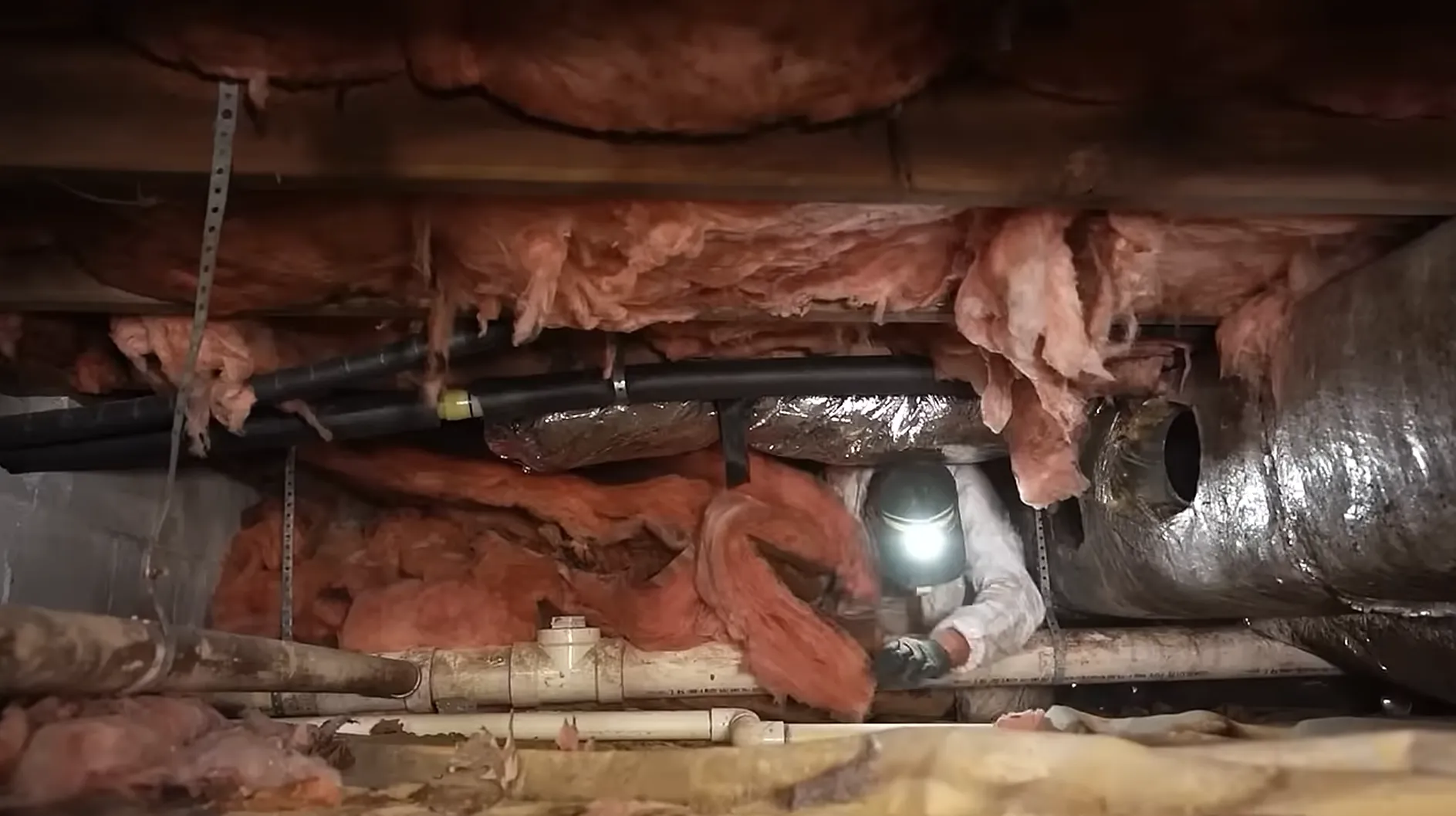
Water intrusion under a home quickly ruins subfloor fiberglass batt insulation. Fiberglass does not absorb water into the glass fibers; instead, it holds water between fibers like a heavy sponge. A single 4-foot section of saturated batt insulation can weigh up to 30 pounds.
-
The Belly Insulation Trap: Waterlogged batts sag away from the subfloor, trapping moisture directly against wood joists and accelerating fungal rot even if air feels dry.
-
Permanent Loss of R-Value: Wet fiberglass loses its insulating properties. Even after drying, compressed fibers permanently lose original thermal efficiency.
-
Pathogen and Pest Attraction: Saturated insulation serves as an ideal nesting site for rodents, termites, and wood-boring insects while harboring heavy mold colonies.
ANSI/IICRC S500 standards mandate the complete removal and disposal of saturated fiberglass batt insulation. Crawl Space Recovery crews safely strip, double-bag, and remove contaminated insulation before applying EPA-registered antimicrobial biocides to all exposed framing.
.webp "Wet Insulation Extraction")
The Stack Effect: Protecting Your Living Area Air Quality
What happens beneath your house directly influences the air you breathe in your living room and bedrooms due to the natural aerodynamic phenomenon known as the Stack Effect.
How the Stack Effect Works:
- Warm air naturally rises inside your home and escapes through attic vents, recessed lights, and ceiling penetrations.
- This upward movement creates a negative pressure zone on the ground floor.
- Your home pulls replacement air upward through subfloor gaps, plumbing chases, electrical penetrations, and ductwork joints.
- Up to 50% of the air on the first floor of your home originates directly from the crawl space.
During structural drying, Crawl Space Recovery operates commercial HEPA 500 air scrubbers under negative pressure to filter 99.97% of airborne particles down to 0.3 microns, keeping your indoor living air safe and clean.
.webp "The Stack Effect Diagram")
Precision Crawl Space Drying: Psychrometric Science and LGR Dehumidification
Pumping out standing water is only the first step. Millions of water molecules deeply absorbed by floor joists, subfloor sheathing, and foundation walls must be extracted through Psychrometric Science, the physics governing air temperature, relative humidity, vapor pressure, and moisture evaporation.
-
Low Grain Refrigerant (LGR) Dehumidifiers: Industrial LGR units remove 130 to 220+ pints of water per day, pre-cooling incoming air to extract moisture down to 33 Grains Per Pound (GPP) of specific humidity.
-
High-Velocity Axial Air Movers: Commercial air movers producing 3,000+ CFM break the boundary layer of saturated air resting against wet framing lumber, pulling bound moisture into the air.
Our IICRC-certified technicians record daily forensic readings (Specific Humidity GPP, Relative Humidity RH%, and Wood Moisture Equivalent % WME) until structural framing reaches our target threshold of under 16% WME.
.webp "Precision Structural Drying")
Post-Flood Vapor Barrier Replacement and Heavy-Duty Liners
Flooding destroys lightweight vapor barriers. Floodwaters float loose plastic, trapping mud, sewage, and stagnant moisture beneath the sheet and creating an active bacterial environment.
Most homes have thin 6-mil polyethylene plastic loosely laid over the dirt floor. This thin sheeting punctures easily, pulls away from foundation walls, and degrades within a few years.
After water extraction, soil sanitization, and structural drying, Crawl Space Recovery installs heavy-duty 12-mil, 16-mil, or 20-mil reinforced vapor barriers with cord-reinforced scrim, zero permeance rating, and 12-inch overlapped seams sealed with waterproof butyl vapor tape.
.webp "Post-Flood Vapor Barrier Replacement")
Navigating Crawl Space Water Damage Insurance Claims
A primary concern among homeowners facing crawl space water damage is whether insurance will pay for the repairs. Coverage depends on the initial cause of water intrusion and how the claim is documented.
-
Covered Under HO-3 Policies: Ruptured supply lines, failed water heater tanks, burst washing machine hoses, frozen pipe breaks, and sudden appliance overflows.
-
Itemized Billing with Xactimate: We provide adjusters with FLIR thermal imaging logs, daily psychrometric moisture records, and standard line items (WTREXT, WTRDRY, WTRAIR, WTRGRM).
We submit billing directly to your insurance company, coordinating with the adjuster so you pay only your applicable policy deductible on covered claims.
.webp "Insurance Claim Documentation")
The 6-Step Forensic Restoration Workflow by Crawl Space Recovery
Our restoration workflow adheres strictly to ANSI/IICRC S500 (Water Damage) and ANSI/IICRC S520 (Mold Remediation) standards:
Emergency Inspection & Moisture Mapping
Call Now. We Answer 24/7. Upon arrival, our technicians inspect the crawl space using FLIR thermal cameras, combustible gas meters, and moisture meters to map moisture boundaries and verify life-safety.
High-Volume Water & Slurry Extraction
Industrial submersible trash pumps (up to 18,000 GPH) and truck-mounted slurry vacuum extraction units remove standing water, mud, and sewage backflow down to the ground level.
Contaminated Material & Insulation Strip-Out
Saturated fiberglass batt insulation acting as a moisture reservoir, ruined vapor barriers, and waterlogged debris are bagged and removed from the property.
EPA-Registered Antimicrobial Bio-Wash
Subfloor framing, floor joists, and foundation stem walls are treated with EPA-registered biocides to eliminate active mold spores, bacteria, and sewage pathogens.
LGR Dehumidification & Structural Drying
Commercial Low Grain Refrigerant dehumidifiers and high-velocity axial air movers operate continuously with daily psychrometric logs until framing drops below 16% WME.
Dry Certification & Heavy-Duty Relining
We issue a formal Certificate of Structural Dry-Out for your insurance carrier and install a clean, heavy-duty 12 to 20-mil reinforced vapor barrier with taped seams.
Nationwide Service Directory: 45 States Covered
Crawl Space Recovery provides dedicated crawl space water damage restoration across 45 US states and over 10,000 local communities. Select your state or enter your city below for instant dispatch:
Interactive 45-State Service Coverage & Direct Dispatch
Crawl Space Recovery maintains decentralized mobile response units stationed across 45 states. Enter your city or click your state below for instant local dispatch.
Frequently Asked Questions About Crawl Space Water Damage
Find fast answers to common questions about crawl space flooding, structural wood drying, insurance coverage, and health risks.
Water should be extracted within 24 to 48 hours of intrusion. After 48 hours, mold spores begin to colonize rapidly, and structural framing absorbs moisture toward the 20% Wood Moisture Equivalent threshold where wood-destroying fungi activate.
Restoration costs generally range from $1,500 to $5,000 or more, depending on standing water depth, water contamination category (Clean vs. Category 3 Sewage), square footage, and structural drying duration. If caused by a sudden plumbing burst or water heater failure, the cost is typically covered by standard homeowners insurance minus your deductible.
Yes. Standing water saturates the soil beneath concrete footings and brick piers, leading to soil settlement and uneven foundation shifting. Lateral hydrostatic pressure against block foundation walls can also cause mortar deterioration, cracking, and inward wall movement.
Musty odors indicate active microbial activity. When rain saturates surrounding soils, moisture vapor rises through the dirt floor. Mold breaking down organic matter on damp wood and insulation releases Microbial Volatile Organic Compounds (MVOCs) that travel into your home via the Stack Effect.
Complete structural drying typically takes 3 to 5 days using commercial Low Grain Refrigerant dehumidifiers and high-velocity air movers. Drying time depends on ambient humidity, initial saturation depth, and framing timber dimensions.
No, foundation vents should remain closed during drying. During warm months, outdoor air carries high humidity. When warm air enters a cool crawl space, it reaches its dew point and condenses on cold joists and ductwork, increasing moisture levels. Crawl spaces must be dried mechanically with dehumidifiers.
Yes. Home inspectors evaluate subfloor moisture levels during property sales. Unresolved water damage, sagging joists, or mold can delay transactions, impact buyer financing, or reduce home value by 10% to 15%. Our Certificate of Structural Dry-Out provides official documentation that repairs were completed to industry standards.
If the water is Category 1 clean water and no electrical hazards are present, staying in the home is generally safe. If the water involves Category 3 sewage or heavy mold growth, airborne contaminants drawn upward by the Stack Effect can cause respiratory irritation. In severe Category 3 situations, temporary relocation or negative air containment is recommended.